
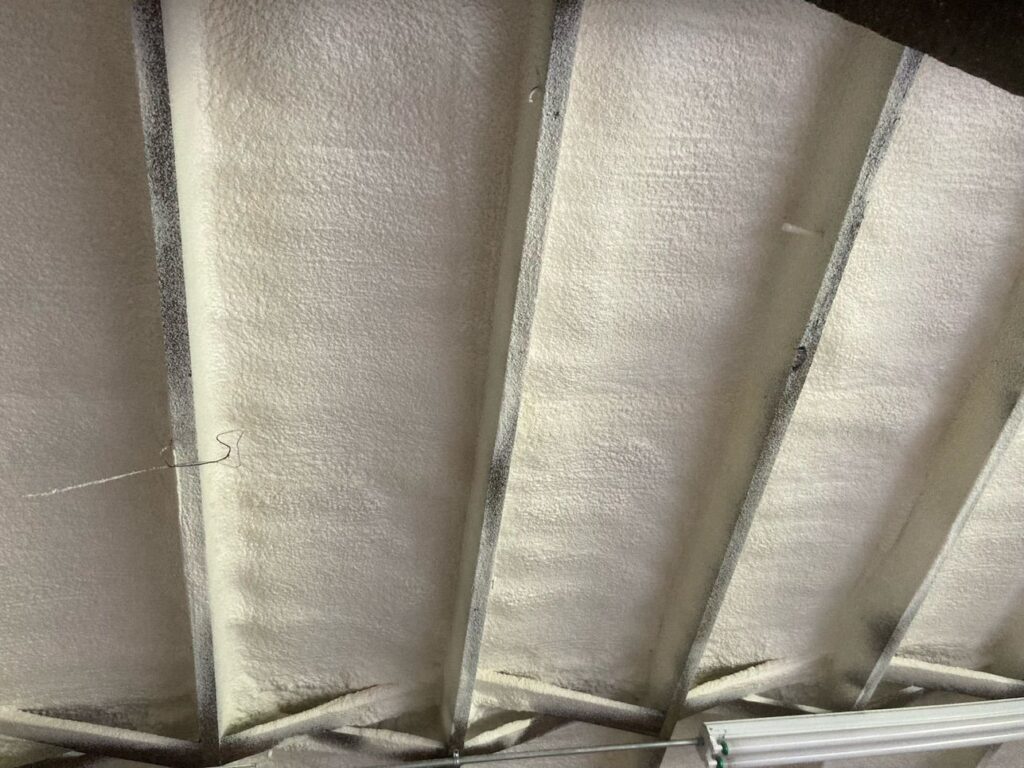
Homeowners and builders often begin with one question: How much does spray foam insulation cost? The more useful question is what creates that price.
The total cost of a spray foam project depends on the foam type, required thickness, total square footage, access, preparation, and the condition of the existing insulation. A small rim-joist project in Murray will be priced differently from a full metal-building application near Paducah, Kentucky.
This guide explains the typical market ranges for closed cell spray foam cost, how open-cell and closed-cell foam compare, and when the higher upfront investment may provide stronger long-term value.
Typical Spray Foam Insulation Cost Ranges
Professional spray foam pricing is commonly calculated by the board foot. One board foot equals one square foot of coverage at one inch thick.
Typical market ranges in 2026 include:
| Material | Typical installed range | Typical R-value per inch |
|---|---|---|
| Open-cell spray foam | About $0.40–$0.75 per board foot | Approximately R-3.5 to R-4 |
| Closed-cell spray foam | About $1.00–$2.00 or more per board foot | Approximately R-6 to R-7 |
These are general market ranges, not firm quotes. Regional labor costs, project size, material availability, access, and preparation can move the final price higher or lower.
For example, a 1,500-square-foot roofline sprayed with approximately 5.5 inches of open-cell foam would involve about 8,250 board feet. A 3-inch closed-cell application over the same area would involve about 4,500 board feet. The material and labor cost can be very different even though the surface area is identical.
A professional spray foam insulation contractor should price the complete scope rather than quoting only a square-foot number.
Closed Cell vs Open Cell: Why the Material Price Differs
Open-Cell Spray Foam
Open-cell spray foam expands significantly and fills gaps around wiring, plumbing, framing, and other obstructions. Its softer structure makes it useful for air sealing and sound control.
Open-cell foam is often selected for:
- Attic rooflines
- Above-grade wall cavities
- Interior partitions
- Applications where sound control is important
- Projects with adequate space for a thicker insulation layer
Open-cell foam usually costs less per board foot than closed-cell foam. However, it commonly requires more thickness to reach a similar total R-value.
Closed-Cell Spray Foam
Closed-cell spray foam is denser and provides a higher R-value per inch. It also resists water absorption and can add rigidity to certain building assemblies.
Closed-cell foam is often selected for:
- Crawlspace walls
- Rim joists
- Metal buildings
- Exterior wall assemblies
- Areas with limited depth
- Locations where moisture control is a major concern
The higher closed cell spray foam cost reflects the denser material, higher performance per inch, and additional moisture-control and structural benefits. Armored Insulation explains the differences in its spray foam insulation service guide.
The higher upfront price is real. The potential return comes from improved air sealing, lower heating and cooling demand, fewer separate air-sealing steps, and long-term durability.

Cost Driver No. 1: Target R-Value and Foam Thickness
Spray foam cost increases with thickness because every additional inch adds board feet.
A project may require different thicknesses depending on the building assembly, local code requirements, climate, moisture exposure, and the desired thermal performance. Open-cell foam may need approximately 9 to 10 inches to approach an R-35 target, while closed-cell foam may reach a similar R-value in approximately 5 to 6 inches.
That does not automatically make closed-cell the cheaper option. Closed-cell costs more per board foot, even though it can achieve a higher R-value in less space.
The right comparison is:
- Required R-value
- Available cavity depth
- Moisture-control needs
- Air-sealing goals
- Total installed cost
- Expected service life
An experienced contractor should explain the recommended thickness instead of simply applying the thickest possible layer.
Cost Driver No. 2: Total Square Footage and Project Size
Larger, continuous projects often have a lower effective cost per square foot because equipment setup, travel, and crew mobilization are spread across more work.
Small jobs can have a higher unit price because the contractor still needs to transport proportioning equipment, prepare the work area, protect surrounding surfaces, and complete cleanup.
For example, a large new-construction project for a builder in Western Kentucky may be more efficient to complete than several small, disconnected areas in an occupied home. A commercial project near Paducah, Kentucky, may also require lifts and additional safety procedures, but its scale can help offset some mobilization costs.
Cost Driver No. 3: The Location Being Insulated
The same spray foam material can have different installation costs depending on where it is applied.
Attics and Rooflines
Attic rooflines require overhead work, protective preparation, and careful coverage around rafters, vents, wiring, and ductwork. An unvented attic assembly may also require additional planning for ventilation changes, ignition barriers, or thermal barriers.
Open-cell foam is often considered for rooflines where moisture conditions are controlled and adequate depth is available. Closed-cell foam may be preferred where condensation resistance and higher R-value per inch are priorities.
Crawlspaces
Crawlspaces can involve limited clearance, uneven ground, moisture concerns, plumbing, and difficult access. Closed-cell spray foam is commonly considered because it provides insulation and air sealing while helping resist moisture movement.
Before insulation is installed, standing water, drainage problems, wood rot, and major moisture sources should be addressed.
Rim Joists
Rim joists are relatively small areas, but they can contribute significantly to drafts and air leakage. Closed-cell spray foam is often used because it can insulate and seal the band-joist area in one application.
Small rim-joist projects may have a higher effective price per square foot because access and setup take time even when the total area is limited.
Walls
Open wall cavities in new construction are generally easier to access than existing walls. Existing walls may require removal of siding or drywall, drilling access holes, or using a different system such as blown-in-wall insulation.
For contractors and builders, scheduling the insulation before drywall installation can simplify access and reduce preparation costs.
Metal Buildings
Metal buildings often have condensation risks, large roof areas, steel framing, and high ceilings. Closed-cell spray foam is frequently considered because it can create a continuous air seal against the underside of metal panels.
Projects may require lifts, extensive masking, mechanical coordination, and work at height. These factors can significantly affect the final estimate.

Cost Driver No. 4: Accessibility and Preparation
A clean, open framing layout is easier to spray than a crowded or occupied space.
Preparation may include:
- Moving or protecting stored belongings
- Covering floors, equipment, windows, and finished surfaces
- Creating safe access to attics or crawlspaces
- Working around ducts, wiring, lights, and plumbing
- Setting up ventilation and personal protective equipment
- Coordinating with electricians, HVAC contractors, or other trades
- Trimming excess foam before drywall installation
A commercial building with high ceilings may require a scissor lift. A residential attic in Mayfield may have a narrow access hatch and limited walking area. Both projects require different labor plans.
These details are part of the price because they affect safety, production speed, cleanup, and final coverage quality.
Cost Driver No. 5: Removing Old Insulation
Old insulation does not always need to be removed. If it is dry, clean, and evenly installed, adding new insulation may be the better value.
Removal and replacement may be appropriate when existing material is:
- Wet or water-damaged
- Contaminated by rodents or pests
- Moldy or musty
- Severely compressed or settled
- Covered with debris
- Blocking access to air leaks or framing problems
Removal adds labor, equipment, disposal, and preparation costs. However, installing new spray foam over contaminated or damaged material can hide problems rather than solve them.
Armored Insulation provides insulation removal and replacement services for projects that require a cleaner starting point.

Spray Foam vs Fiberglass Batts and Blown-In Insulation
Fiberglass batts and blown-in insulation typically have a lower day-one price than spray foam. Batts work well in open, uniform wall cavities. Blown-in fiberglass or cellulose is useful in attics and irregular spaces because it can flow around wires, ductwork, framing, and tight corners.
Spray foam costs more, but it provides benefits that traditional insulation does not provide by itself:
- Continuous air sealing
- Reduced drafts and uncontrolled air movement
- High R-value per inch, especially with closed-cell foam
- Strong coverage around difficult penetrations
- Reduced HVAC load
- Durable performance without sagging when properly installed
- Improved acoustic tightness
Fiberglass batts and blown-in materials still have an important place in construction. They may be the practical choice for a budget-focused project with straightforward framing and good air-sealing details.
The best life-cycle comparison should consider more than the initial invoice:
- Energy demand: A better-sealed building may require less heating and cooling.
- HVAC sizing: New construction may be able to use a smaller HVAC system when the building envelope is designed correctly.
- Future air sealing: Spray foam can combine insulation and air sealing, while batts and blown-in insulation may require additional sealing work.
- Durability: Properly installed spray foam maintains its form and coverage over time.
- Moisture control: Closed-cell foam may be valuable in crawlspaces, rim joists, and metal buildings where moisture movement is a concern.
For a detailed comparison of batts and blown-in insulation, review Armored Insulation’s guide to fiberglass batt vs. blown-in insulation.
What to Ask Before You Sign
Before hiring a spray foam insulation contractor in Murray, Mayfield, Paducah, or elsewhere in Western Kentucky, ask:
- Which foam type is recommended, and why?
- What thickness and R-value will be installed?
- Is the price based on board feet, square feet, or a complete project scope?
- Does the estimate include air sealing, masking, trimming, cleanup, and disposal?
- Does old insulation need to be removed?
- Are ignition or thermal barriers required?
- How will ventilation and occupant safety be handled?
- What areas will remain accessible after installation?
- Is the contractor insured and experienced with similar projects?
- Will the final work be inspected for consistent coverage?
A clear estimate should identify the material, thickness, areas included, preparation, exclusions, and any recommended follow-up work.
Choosing the Right Insulation for Your Building
There is no single spray foam system for every home or commercial property. Open-cell spray foam, closed-cell spray foam, fiberglass batts, and blown-in insulation all have useful applications.
The right choice depends on the building assembly, moisture conditions, access, target R-value, budget, and long-term performance goals. For homeowners seeking energy efficient home insulation and contractors planning reliable project schedules, professional evaluation is the best place to start.
Armored Insulation serves Western Kentucky, including Murray, Mayfield, and Paducah, Kentucky, as well as Northwest Tennessee, Southern Illinois, and Southeastern Missouri. We provide spray foam, batts, blown-in insulation, and insulation removal for residential and commercial projects.
Request a project review through our Jobber service request form. We will review the scope, explain the options, and respond with practical recommendations for your building.