
When summer temperatures climb across Western Kentucky, Northwest Tennessee, Southern Illinois, and Southeastern Missouri, your air conditioner works hard to keep your home comfortable. On extremely hot days, however, the problem may not be your AC system. Your home may be allowing too much heat inside.
A hot roof and poorly insulated attic can push heat into living spaces for hours. Air leaks can allow cooled air to escape. Ductwork in the attic may lose efficiency in the hottest part of the house. The result is longer AC run times, uneven temperatures, and rising energy bills.
The right energy efficient home insulation and professional air sealing can help keep cool air inside, reduce AC strain, and create meaningful cost savings on energy bills.
Why Your Attic Gets So Hot
Your roof absorbs solar energy throughout the day. On a sunny afternoon, the roof deck and framing can become much hotter than the outdoor air. That heat moves into the attic through the roof materials and then toward the rooms below.
A vented attic is designed to release some heat and moisture. Ventilation alone, however, does not stop heat from entering the attic. If the attic floor is under-insulated or the ceiling plane has gaps, the heat can move directly into your home.
According to the Pacific Northwest National Laboratory, heat gain through the roof or attic can account for approximately 15% to 25% of a building’s total heat gain.
That heat enters your home in several ways:
- Conduction: Heat travels through thin or missing insulation, ceiling drywall, and framing.
- Air leakage: Hot attic air enters through gaps around recessed lights, wiring, plumbing, attic hatches, and exhaust fans.
- Radiant heat: A hot roof deck and attic floor can radiate heat toward the living space.
- Duct losses: Ducts located in a hot attic can gain heat, lose cooled air, or both.

How Attic Heat Increases AC Strain
Your AC system must remove heat from the home. When heat constantly enters through the roof and attic, the system has to work longer to reach the thermostat setting.
Homeowners may notice:
- The AC runs nearly nonstop during peak afternoon hours.
- Upstairs bedrooms remain warmer than downstairs rooms.
- The thermostat reaches its setting slowly.
- Rooms feel humid even when the temperature seems acceptable.
- The home becomes uncomfortable again soon after the AC turns off.
- Monthly cooling costs rise during every extended heat wave.
This does not necessarily mean the air conditioner is failing. It may mean the building envelope is allowing too much heat and outside air to pass through.
A properly insulated and air-sealed attic acts as a protective thermal barrier. It does not make the AC unnecessary, but it helps the system do its job with less effort. The AC can reach the target temperature more efficiently and maintain it for longer periods.
Air Sealing Comes Before More Insulation
Adding insulation over large air leaks is not the most effective approach. Before new insulation is installed, the attic and ceiling plane should be checked for openings that allow air to move between the home and the attic.
Common problem areas include:
- Attic access doors and pull-down stairs
- Recessed lighting fixtures
- Plumbing and electrical penetrations
- Gaps around ceiling fans
- Bathroom and kitchen exhaust fans
- Wiring holes and framing joints
- Open soffits or dropped-ceiling areas
- Duct boots and other HVAC penetrations
Air sealing closes these pathways. This helps keep conditioned air inside during the summer and prevents warm indoor air from escaping into the attic during the winter.
The ENERGY STAR attic guidance states that homeowners can save an average of approximately 15% on heating and cooling costs by air sealing their homes and adding insulation in attics, floors over crawl spaces, and basements.
The exact savings depend on the home’s size, construction, existing insulation, HVAC system, ductwork, and air leakage. No contractor can responsibly guarantee the same percentage for every property. However, sealing obvious leaks and correcting insufficient insulation can provide measurable comfort and efficiency improvements.
Choosing the Right Attic Insulation
The best material depends on the attic design, existing conditions, budget, moisture considerations, and the location of the home’s thermal boundary.
Spray Foam Insulation
Spray foam insulation expands to fill gaps, cracks, and irregular spaces. It can create a seamless air seal in areas where traditional insulation may leave openings.
Armored Insulation installs both open-cell and closed-cell spray foam systems.
- Open-cell spray foam is lightweight, flexible, and effective for air sealing and sound control. It expands significantly and can fill around wiring, pipes, and other obstructions.
- Closed-cell spray foam is denser and provides a higher R-value per inch. It also resists air and moisture movement and can add rigidity to certain building assemblies.
Spray foam may have a higher upfront cost than batt or blown-in insulation. That cost should be considered alongside its long-term benefits, including improved air sealing, reduced HVAC strain, moisture control in appropriate applications, and lasting performance.
Learn more about Armored Insulation’s spray foam services.
Blown-In Fiberglass and Cellulose
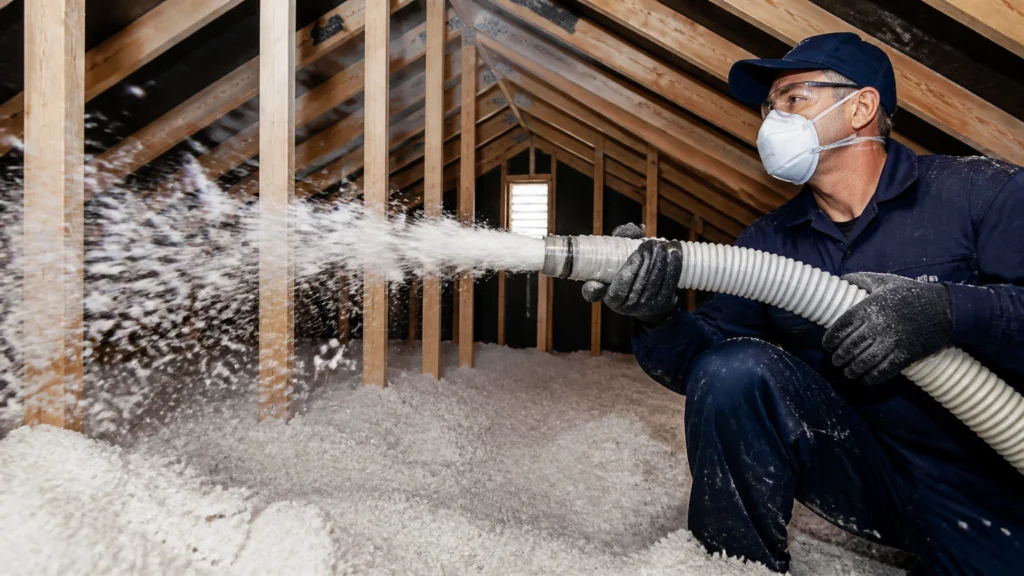
Blown-in insulation is often a practical choice for existing attic floors. Loose-fill material can cover joists evenly and reach tight corners around ductwork, wiring, and framing.
It can be especially useful when an attic has:
- Thin or uneven insulation
- Exposed attic floor areas
- Difficult-to-reach corners
- Irregular framing
- Existing insulation that has settled or shifted
Blown-in fiberglass and cellulose are generally cost-effective options for increasing attic insulation depth. They work best when installed over a properly air-sealed attic floor with adequate ventilation pathways at the eaves.

Fiberglass Batt Insulation
Fiberglass batt insulation remains a reliable and affordable option when the attic or ceiling assembly has accessible, regularly spaced cavities.
Batt insulation can be a good fit for:
- New construction
- Open framing
- Straightforward attic areas
- Homeowners working within a defined budget
Its performance depends heavily on installation quality. Batts should fit cavities closely without compression, gaps, or excessive overlap. Irregular areas may require another material or additional air sealing to achieve continuous coverage.
Should the Attic Floor or Roof Deck Be Insulated?
This is an important design decision.
In a traditional vented attic, insulation is typically installed at the attic floor. This keeps the attic outside the home’s conditioned space while protecting the rooms below.
In some homes, insulation is installed along the underside of the roof deck. This approach can bring the attic closer to the home’s conditioned envelope, which may be beneficial when HVAC equipment or ductwork is located in the attic.
Spray foam under the roof deck may be considered for:
- Attics with HVAC equipment
- Cathedral ceilings
- Complex rooflines
- Attic conversions
- Homes with difficult-to-seal attic floors
This application requires careful planning. The roof assembly, ventilation strategy, moisture control, and local building requirements should all be evaluated before work begins.
When Old Insulation Needs to Be Removed
Not all insulation needs to be removed before new material is installed. In some cases, existing insulation can remain if it is clean, dry, and in usable condition.
Removal and replacement may be appropriate when insulation is:
- Water damaged
- Pest contaminated
- Mold affected
- Heavily compressed or settled
- Covered in debris
- Missing from large sections
- Unable to provide consistent coverage
Professional insulation removal services help prepare the attic for a cleaner and more effective upgrade. Armored Insulation can remove ineffective material and install a new insulation system suited to the home.
Visit the insulation removal and replacement service page to learn more.
Other Ways to Reduce Summer Heat Gain
Insulation and air sealing are usually the first priorities, but other improvements may also help:
- Keep soffit and ridge vents clear in a properly vented attic.
- Seal and insulate attic ductwork.
- Confirm that bath and kitchen exhaust fans vent outdoors.
- Consider reflective roofing materials during a future roof replacement.
- Use shade from trees or exterior features where practical.
- Have the HVAC system inspected if it still runs excessively after envelope improvements.
Attic fans are not a substitute for insulation and air sealing. If the ceiling plane is leaky, a fan can sometimes pull conditioned air from the home into the attic. The attic assembly should be evaluated as a complete system rather than treated with a single product.
Make Your Home More Efficient Before Replacing the AC
A high-efficiency AC system can be a valuable investment, especially when an existing unit is old or failing. However, replacing the equipment without correcting major insulation and air leakage problems may leave the same comfort issues in place.
An efficient home envelope can help:
- Reduce cooling demand
- Improve room-to-room temperature balance
- Lower AC runtime
- Support better humidity control
- Reduce wear on HVAC equipment
- Improve winter performance as well as summer comfort
The right solution may be a combination of air sealing, blown-in insulation, batt insulation, spray foam, or insulation removal and replacement. A professional assessment can identify the most practical path for the home.
Get a Free Estimate from Armored Insulation
Extreme heat exposes weak points in a home. If your attic is under-insulated, your ceiling has visible gaps, or your AC runs constantly on hot afternoons, an insulation upgrade may be worth considering.
Armored Insulation, LLC provides residential attic insulation services throughout Western Kentucky, Northwest Tennessee, Southern Illinois, and Southeastern Missouri. Our team evaluates the existing conditions and recommends a safe, effective, and competitively priced solution.
Request your free estimate today. We will be glad to answer your questions and help you determine how the right insulation and air sealing can improve comfort and support long-term cost savings on energy bills.