


A dry crawl space creates a quieter home primarily by stabilizing the wooden structures above it and eliminating moisture-related problems that generate noise. When a crawl space is damp, the excess humidity is absorbed by the subfloor, joists, and beams. This causes the wood to swell and then shrink as humidity levels change, leading to creaks, groans, and pops as the structural components shift and rub against each other. High moisture also attracts noisy pests and can force HVAC systems to run louder and more often. By controlling moisture, you address these root causes of noise directly.
This article explains the specific ways a damp crawl space generates sound and how drying and sealing this area can significantly reduce unwanted indoor noise. The information comes from years of direct experience in building science and moisture management, focusing on how the unseen environment below your floors affects your daily life.
Unwanted sounds from below your feet often trace back to one single problem: excess moisture. This moisture manifests in several ways, each creating its own unique type of auditory disturbance.
The most common source of floor noise is the natural reaction of wood to moisture. Wood is hygroscopic, meaning it absorbs and releases water from the air. A report from the U.S. Forest Service explains that wood changes dimension as its moisture content fluctuates.
In a damp, uncontrolled crawl space, humidity levels can swing wildly.
This constant cycle of expansion and contraction puts stress on fasteners like nails and screws, loosens joints, and causes floorboards to rub against each other. The result is a symphony of pops, squeaks, and creaks every time you walk across the floor. A dry crawl space keeps humidity levels stable, which in turn keeps the wood’s dimensions consistent, preventing this noise-causing movement.
Damp, dark, and cluttered crawl spaces are highly attractive to a variety of pests. According to the U.S. Environmental Protection Agency, controlling moisture is key to controlling pests. Rodents, termites, and other insects seek out these environments for shelter and breeding. Once they’ve moved in, they create noise through:
By drying out a crawl space and sealing entry points, you make the area inhospitable to these unwanted guests, removing them and their associated noises from your home.
Your home’s heating and cooling system is often located or routed through the crawl space. Excess humidity below the home affects this system in two main ways. First, humid air is harder and more energy-intensive to cool and heat. Research from the U.S. Department of Energy shows that high indoor humidity can make an air conditioner work harder to make the space feel comfortable. This extra strain can lead to the HVAC unit running longer and louder.
Second, if ductwork in the crawl space has leaks, it can pull in damp, musty air. This not only degrades indoor air quality but can also lead to condensation on and inside the ducts. This moisture can cause metallic ducts to make ticking or popping sounds as they heat and cool. Keeping the crawl space dry reduces the load on your HVAC system and protects the ductwork, creating an ideal environment for insulation to further dampen sound.
Once moisture is controlled with a proper vapor barrier and dehumidifier, insulation becomes the next line of defense against noise. Different insulation materials have varying abilities to absorb sound waves and reduce vibrations.
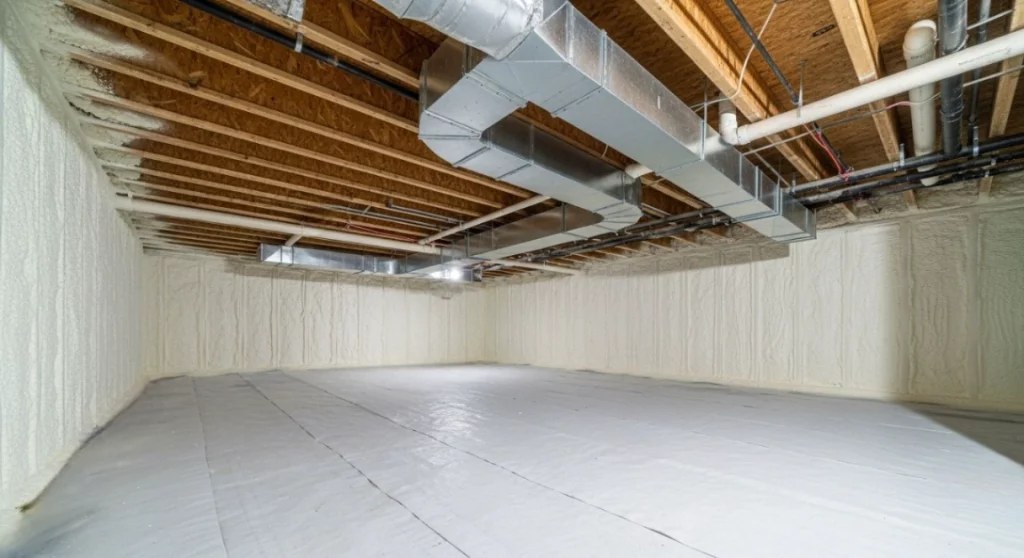
Insulation doesn’t just manage temperature; it also absorbs sound. Closed-cell spray foam, for instance, is highly effective at this. When applied to the crawl space walls and rim joists, it creates a rigid, airtight seal. This seal does two things: it stops airborne sound from passing through gaps, and its cellular structure absorbs vibrations traveling through the foundation walls and floor system.
Bonus Tip: When insulating a crawl space for sound, pay special attention to the rim joist area. This is where the house framing rests on the foundation, and it’s a major point of entry for both outside noise and vibrations.
Different insulation materials offer different levels of sound dampening. While thermal resistance (R-value) is the primary measure for insulation, its acoustic properties are also important in this context.
| Insulation Type | Primary Installation Method | Sound Dampening Characteristics |
|---|---|---|
| Closed-Cell Spray Foam | Sprayed onto foundation walls/rim joist | Excellent. Creates a rigid air seal and dampens structural vibrations. |
| Foam Board | Mechanically fastened to walls | Good. Effective at blocking airborne sound, less so for vibrations. |
| Fiberglass Batts | Placed between floor joists | Fair. Absorbs some airborne sound but can trap moisture if not sealed. |
| Rockwool Batts | Placed between floor joists/walls | Very Good. Dense material is excellent for absorbing airborne sound. |
Before you invest in drying or encapsulating your crawl space, it’s good to evaluate a few key factors to ensure you’re choosing the right solution.
Bonus Tip: Check your crawl space vents. In many modern building science applications, sealing crawl space vents is recommended to prevent humid outdoor air from entering, but this should only be done as part of a complete encapsulation and conditioning strategy.
Unexplained creaks, groans, and scratching sounds are often symptoms of an unhealthy crawl space, not just random annoyances. By addressing the root cause—excess moisture—you solve the noise problem at its source rather than masking the symptoms. A dry, sealed, and properly insulated crawl space provides a comprehensive solution that stabilizes your home’s structure, deters pests, and improves mechanical system performance. To ensure you choose the right approach for your home’s specific needs, it is important to start with a proper evaluation.
If you’re dealing with mysterious floor squeaks or other noises and think your crawl space could be the issue, understanding the full picture is the best first step. For a thorough evaluation and to understand what your home needs, you can connect with the experienced team at Armored Insulation. Contact us by calling (270) 331-4844 or sending an email to [email protected] to discuss your home’s environment.
Crawl space encapsulation is the process of completely sealing the crawl space from the ground and the outside air. This typically involves installing a heavy-duty, reinforced vapor barrier across the entire floor and up the foundation walls, sealing all seams, and closing off foundation vents. Often, a dehumidifier is added to actively condition the air.
While laying down plastic sheeting from a hardware store is possible, it’s not the same as a professional encapsulation system. Professional vapor barriers are much thicker, puncture-resistant, and are properly sealed at all seams and around piers. A DIY job often fails to create the complete seal needed to effectively control moisture.
Absolutely. A significant portion of the air you breathe inside your home originates from the crawl space due to a phenomenon called the “stack effect,” where air naturally rises. A damp, moldy crawl space releases mold spores, dust mite allergens, and musty odors into your living area. A dry, sealed crawl space ensures cleaner, healthier air is rising into your home.
Yes. The main benefits of a dry and encapsulated crawl space are improved structural integrity by preventing wood rot, better indoor air quality, increased energy efficiency by reducing the load on your HVAC system, and the elimination of pests. The quieter environment is a very pleasant result of solving these other foundational issues.